
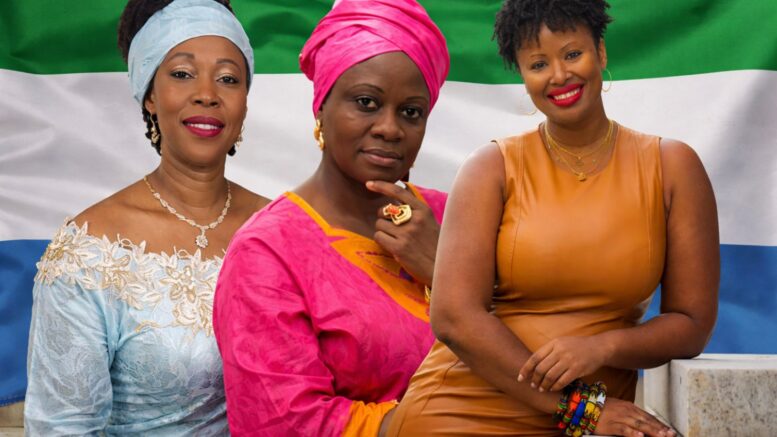
Three Faces of Power: How Fatima Maada Bio, Sylvia Olayinka Blyden, and Vickie Remoe Shape Sierra Leone’s Image
A Comparative Analysis of State Authority, Political Contest, and Cultural Narrative
Sierra Leone’s public life is not shaped by one type of influence. It moves through different channels—government authority, political debate, and public storytelling. Three women stand out across these layers: Fatima Maada Bio, Sylvia Olayinka Blyden, and Vickie Remoe. Each operates in a different space, reflects a distinct ideology in practice, and shapes how Sierra Leone is seen at home and abroad.
This analysis compares their ideas, their controversies, and their impact on the country’s global image.
 Three Lanes of Influence
These three women do not compete in the same arena. They work in separate but connected lanes.
Fatima Maada Bio operates inside state power. As First Lady, she uses visibility and access to push social causes. Her work centers on women and girls, especially through public campaigns.
Sylvia Blyden operates in a political contest. She uses media, commentary, and political alliances to influence governance debates. Her voice is direct and often confrontational.
Vickie Remoe operates in the cultural and digital space. She builds narratives about Sierra Leone through media, branding, and storytelling. She targets both local and diaspora audiences.
These roles define how each woman thinks, speaks, and acts.
Ideological Differences in Practice
Fatima Maada Bio presents a form of state-backed social advocacy. Her message focuses on protection, dignity, and opportunity for women and girls. She uses national platforms to promote change. Her approach depends on moral authority tied to public office. She does not argue policy in technical terms. She frames issues as matters of justice and national responsibility.
Sylvia Blyden reflects political realism shaped by partisan struggle. Her work centers on power, governance, and accountability. She does not separate journalism from political engagement. Her ideology shows in how she confronts opponents and defends allies. She treats politics as a contest that must be fought openly.
Vickie Remoe reflects narrative-driven civic entrepreneurship. She focuses on how Sierra Leone is seen and understood. Her work promotes identity, creativity, and possibility. She avoids deep party alignment. Instead, she frames national progress through storytelling, media, and global connection.
In simple terms:
- Bio speaks as a state advocate
- Blyden speaks as a political actor
- Remoe speaks as a nation builder through narrative
Public Controversies and Their Meaning
Each woman’s controversies follow the structure of her role.
Fatima Maada Bio faces criticism tied to the tension between advocacy and state power. Her position on female genital mutilation created debate. Critics expected a clear stance based on global human rights norms. Her response reflected caution shaped by local cultural realities. This gap drew international attention. Another controversy came from her involvement in the Koidu mining dispute. Supporters saw her as defending workers. Critics saw possible overreach. These events show the risk of operating close to executive power. Every action carries national weight.
Sylvia Blyden’s controversies are direct and political. Her detention and charges in 2020 drew attention from press freedom groups. Supporters viewed her as a target of state pressure. Critics viewed her as a polarizing figure who uses aggressive tactics. Her long record of strong commentary has built both influence and opposition. Her controversies reflect the nature of political combat in Sierra Leone. They show how media and politics often overlap.
Vickie Remoe has fewer formal controversies. Her challenges are reputational. Some critics question shifts in her public positions, especially regarding government performance. Others see these shifts as independence. The debate around her is less about law or power and more about credibility and consistency. This reflects her position outside formal authority.
Impact on Sierra Leone’s Global Image
Each woman projects a different image of Sierra Leone to the world.
Fatima Maada Bio gives Sierra Leone official visibility in global advocacy spaces. She presents the country as active on women’s rights and social issues. Her presence at international events increases recognition. However, controversies tied to her actions can also raise concerns about governance and policy consistency. She amplifies both opportunity and scrutiny.
Sylvia Blyden projects Sierra Leone as a politically active and contested democracy. Her voice shows that strong debate exists. She signals that women can occupy hard political space. At the same time, her confrontational style can reinforce an image of political tension and division. She highlights the intensity of the country’s public sphere.
Vickie Remoe projects Sierra Leone as a modern, creative, and emerging society. Her work focuses on culture, business, and storytelling. She presents the country beyond crisis narratives. She connects Sierra Leone to global audiences through media and digital platforms. Her influence builds soft power and positive perception.
Structural Insight: Three Layers of Power
These three figures reveal a broader structure in Sierra Leone:
- State Power → represented by Fatima Maada Bio
- Political-Media Power → represented by Sylvia Blyden
- Narrative and Soft Power → represented by Vickie Remoe
Each layer shapes a different outcome:
- Policy and advocacy
- Political debate and accountability
- National image and global perception
No single layer is enough on its own. Together, they form a complete system of influence.
Conclusion
Fatima Maada Bio, Sylvia Blyden, and Vickie Remoe do not represent the same kind of leadership. They represent three distinct ways power works in Sierra Leone.
Fatima Maada Bio uses office and visibility to push social causes.
Sylvia Blyden uses media and political alignment to fight ideological battles.
Vickie Remoe uses storytelling to shape how the country is seen.
Their differences are not weaknesses. They show range. They show that influence in Sierra Leone does not come from one source.
It comes from authority, from contest, and from narrative.
And each of these women stands at the center of one of those forces.