
The Battle for Biriwa: How Political Parties and Ethnicity Divide Traditional Power in Sierra Leone
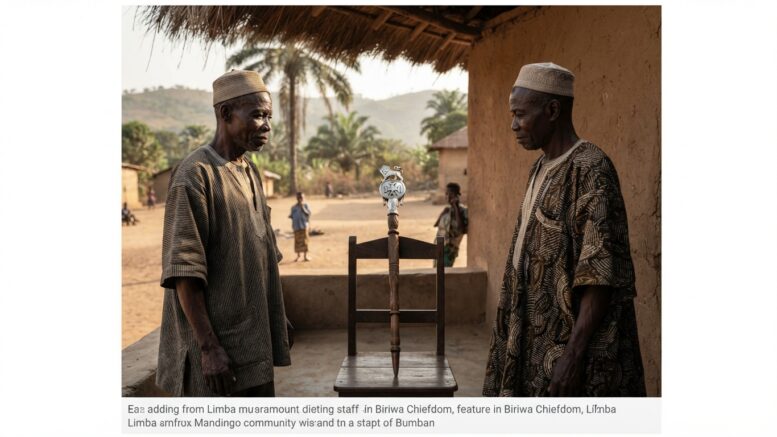
BOMBALI DISTRICT, SIERRA LEONE — A deep struggle for traditional authority divides the residents of Biriwa Chiefdom in northern Sierra Leone. The conflict pits the Limba and Mandingo ethnic groups against each other. It shows how national political parties interfere with local traditions to control local votes.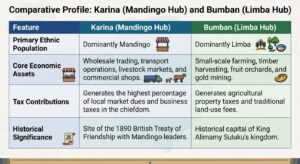
In Sierra Leone, Paramount Chiefs hold lifelong power. They govern local land use and influence how their communities vote in national elections. This authority makes chiefdoms a major target for national political parties that want to build a regional power base.
Two Groups, Two Claims to the Throne
The conflict in Biriwa involves two groups with different ideas about political rights:
- The Limba Group: This group considers itself the original owner of the territory. Limba leaders cite the legacy of King Alimamy Suluku, a powerful 19th-century ruler who expanded Biriwa and established his capital at Bumban. The Limba argue that customary laws reserve the chieftaincy strictly for Limba ruling houses, like the Kalawa family.
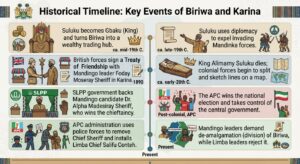
- The Mandingo Group: Centered in the commercial town of Karina, this community settled in the area generations ago. They point to an 1890 British treaty signed with a Mandingo leader as proof of their historic status. Today, Mandingo merchants run major transport businesses and pay the highest percentage of local taxes in the chiefdom. They argue that their economic contributions and population size give them a fair right to run for office.
National Parties Interfere in Local Elections
National political parties use these ethnic divisions to secure votes. The two dominant parties in Sierra Leone are the Sierra Leone People’s Party (SLPP) and the All People’s Congress (APC). The Mandingo community strongly supports the SLPP, while the APC maintains deep historical ties to the Limba group.
In August 2006, the SLPP-led national government conducted a Paramount Chieftaincy election in Biriwa. Limba candidates believed the government favored their rivals, so they boycotted the vote at the last minute. As a result, Dr. Alpha Madesiray Sheriff, a Mandingo candidate backed by the SLPP, won the election and became the Paramount Chief.
Power Shifts Bring Forced Dethronement
The local political balance broke one year later. In 2007, the rival APC party won the national election and took control of the central government. The new administration quickly targeted Chief Sheriff to reward its own ethnic support base.
By 2011, the APC government used state police forces to remove Chief Sheriff from power. Government agents seized his official staff of office. The administration then installed a Limba chief, Salifu Conteh, to replace him. The government did not hold a new democratic election to authorize this change.
Modern Standoff and the Demand to Split the Land
The dispute remains unresolved today and causes frequent local security threats. Because the two sides cannot agree on a single leader, Mandingo leaders now campaign for the de-amalgamation, or official division, of Biriwa Chiefdom. They want the government to split the territory into two separate chiefdoms so that each ethnic group can govern its own affairs.
Limba leaders strongly reject this plan. They argue that splitting the chiefdom violates ancestral borders and destroys the historical legacy of King Suluku. This ongoing standoff shows that when national politicians interfere with traditional local leadership, they weaken long-term regional stability.
Regional Profile: Karina versus Bumban
| Feature | Karina (Mandingo Hub) | Bumban (Limba Hub) |
|---|---|---|
| Primary Population | Dominantly Mandingo | Dominantly Limba |
| Core Economic Assets | Wholesale trading, transport operations, livestock markets. | Small-scale farming, timber harvesting, gold mining. |
| Tax Contributions | Generates the highest market dues and business taxes. | Generates agricultural property taxes and land fees. |
| Historical Anchor | Site of the 1890 British Treaty of Friendship. | Historical capital of King Alimamy Suluku. |
Case Study Vocabulary
- De-amalgamation: The official splitting of a single administrative region or chiefdom into separate, independent territories.
- Hinterland: The remote, inland areas of a country located far from the main coastal cities or the capital.
- Customary Law: A set of traditional rules and practices that a local community accepts as legally binding obligations.
- Boycott: A protest where a group intentionally refuses to participate in an election or event to show disapproval.
- Dethronement: The forced removal of a chief or monarch from a position of power.


Be the first to comment on "The Battle for Biriwa"