Sierra Leone’s Media Divide | The Chart That Exposed a Nation’s Fractured Public Voice
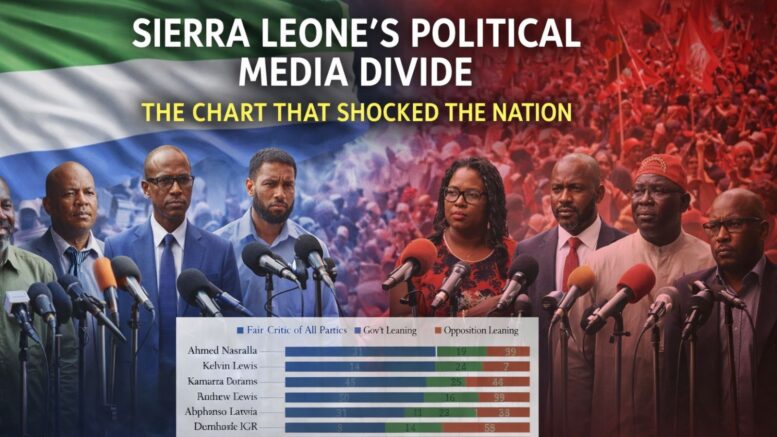
A new political scorecard shared by Sierra Leone’s Minister of Information, Chernor Bah, has triggered a hard national question: Has the country’s media and civil society stopped serving the public and started serving political camps?
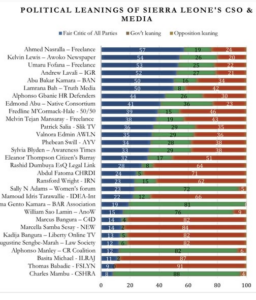 The chart, titled Political Leanings of Sierra Leone’s CSO & Media, does more than rank journalists and civic voices. It maps a widening divide inside Sierra Leone’s public discourse. It places some of the country’s best-known media figures, commentators, and civil society actors on a political spectrum that measures three dimensions: fair criticism of all parties, government-leaning, and opposition-leaning.
What appears at first to be a simple political classification quickly becomes something deeper: a mirror of Sierra Leone’s democratic tension.
At the top of the chart stands Ahmed Nasralla, a Freelancer, scoring 57 as a fair critic of all parties, with slight leanings toward the government and the opposition. Kelvin Lewis of Awoko Newspaper, Umaru Fofana, and Andrew Lavali of IGR follow closely behind. These names suggest that a few respected figures still command enough public trust to challenge both sides.
But below that top layer, the picture shifts sharply.
Many names fall into clear political camps.
Some figures show heavy opposition leanings. Others show strong government alignment. In several cases, balanced criticism almost disappears. The farther down the list, the more visible the polarization becomes.
This matters because media and civil society hold a special duty in any democracy. Their role is not to act as political extensions of ruling parties or opposition blocs. Their duty is to question power, test facts, expose abuse, and protect public trust.
When those institutions begin to divide into partisan camps, citizens lose something vital: a neutral ground where truth can still stand above party loyalty.
The chart reveals that Sierra Leone’s public information space may now be operating inside political trenches.
Take the pattern carefully.
Journalists like Ahmed Nasralla, Kelvin Lewis, and Umaru Fofana still appear to retain broad credibility because they criticize across party lines. That balance gives them democratic weight. Their influence rests not on pleasing one camp, but on holding all camps accountable.
By contrast, several others now appear deeply identified with either government or opposition narratives. Once a journalist or activist becomes seen mainly as a political actor, public confidence weakens. Their facts may still be valid, but audiences begin filtering every message through suspicion.
That is where Sierra Leone now faces danger.
The country is already under strain from economic hardship, rising public frustration, youth unemployment, political mistrust, and post-election divisions. In such an atmosphere, a divided media can deepen national instability rather than calm it.
A polarized media landscape creates three immediate risks:
First, truth becomes tribal.
Facts are no longer judged on evidence, but on who delivers them.
Second, citizens retreat into echo chambers.
Supporters of each political side consume only information that confirms their beliefs.
Third, national unity erodes.
Instead of building shared understanding, public debate becomes constant political warfare.
Chernor Bah’s decision to call the analysis “solid for the most part” gives this chart political weight. It signals that even within government, there is recognition that Sierra Leone’s information environment is under strain.
Yet the chart also raises serious ethical questions.
Who defines political leaning?
What standards measure fairness?
Can such classifications themselves shape public bias against journalists?
These questions matter because labeling journalists can become dangerous if it shifts from analysis into political branding. In fragile democracies, perception can damage reputations as much as facts.
Still, whatever its imperfections, this chart has touched a nerve because many Sierra Leoneans already sense the same truth in daily life: the country’s media space no longer feels neutral.
Radio debates have grown sharper. Facebook commentary has become more hostile. Civil society statements are increasingly read as political positioning rather than public advocacy.
The real issue, then, is not the chart itself.
The real issue is what the chart reveals.
Sierra Leone may be reaching a point where rebuilding public trust in journalism has become as important as rebuilding trust in politics itself.
The nation cannot heal political division if the institutions meant to guide public understanding are themselves divided into camps.
In the end, this report card is more than a ranking sheet.
It is a warning signal.
And Sierra Leone must now decide whether its media will return to being a watchdog for the people—or remain a battlefield for partisan influence.



Be the first to comment on "When journalists choose sides, who speaks for the nation?"