
SLPP First Year of Delivering on Promises
A Mandate Forged in Controversy
On June 24, 2023, Sierra Leone held its fifth general election since the end of its decade-long civil war. The official results, announced by the Electoral Commission for Sierra Leone (ECSL), declared incumbent President Julius Maada Bio of the Sierra Leone People’s Party (SLPP) the victor. President Bio secured 1,566,932 votes, or 56.17%, narrowly surpassing the 55% threshold required to avoid a second-round runoff. His primary challenger, Dr. Samura Kamara of the All People’s Congress (APC), garnered 1,148,262 votes, representing 41.16% of the total.
The parliamentary election delivered an even more decisive outcome for the ruling party. The SLPP won a commanding majority, taking 81 of the 135 directly elected seats in the 149-member Parliament—a remarkable gain of 32 seats from the previous legislature. The opposition APC secured the remaining 54 directly elected seats, a loss of 14. The full Parliament also includes 14 Paramount Chiefs who are indirectly elected from the country’s rural districts.
However, the declaration of victory was immediately met with significant contention. The APC rejected the results outright, alleging “glaring irregularities” and calling for a rerun of the election. The opposition’s stance was not isolated. Major international and domestic observers raised serious questions about the integrity of the electoral process. A joint statement from the United States, United Kingdom, France, Germany, and Ireland expressed concern over a “lack of transparency in the tabulation process”. The Carter Center noted that unusual variances between the presidential and parliamentary results “heighten doubts about the credibility of the tabulation process” and called on the ECSL to release polling-station-level data to allow for independent verification. The European Union’s observation mission similarly pointed to “statistical inconsistencies” in the presidential results.
This widespread questioning of the election’s credibility had tangible consequences. The international rights organization Freedom House downgraded Sierra Leone’s scores for political rights and the electoral process, stating that the flaws “undermined the democratic legitimacy of executive and legislative officeholders”. In protest, the 54 elected APC members of Parliament initially boycotted the legislature, refusing to take their seats and creating a political standoff that lasted for months. The impasse was only resolved in October 2023 after the signing of a national unity agreement, which paved the way for the opposition to join the governance process.
This contested start to President Bio’s second term created a challenging political environment. With its mandate questioned by both the primary domestic opposition and key international partners, the SLPP government faced what could be described as a “legitimacy deficit.” This context became a powerful, non-negotiable catalyst for the administration’s subsequent actions. The government could not simply rely on its declared victory; it had to actively and visibly demonstrate its right to govern. This imperative helps explain the intense focus on performance and the framing of its first-year review as the “360-Day Accelerated Delivery Report”.
The drive to produce tangible, verifiable results in key sectors was not just about fulfilling campaign promises—it was a strategic necessity to build public trust, consolidate its authority, and prove its effectiveness to a watching nation and world. The policies and projects that followed were, in large part, a direct response to this need to turn a contested mandate into undeniable progress on the ground.
The Human Capital Engine: Education and Youth
At the core of the SLPP government’s long-term vision is the development of Sierra Leone’s human capital, which President Bio called the nation’s “single biggest treasure.” This strategy operates on two parallel tracks: a foundational, long-term investment in universal education and a pragmatic, short-term focus on tackling the urgent crisis of youth unemployment.
Pillar 1: Free Quality School Education (FQSE)
The Free Quality School Education (FQSE) program, first launched in 2018, remains the government’s flagship policy. It provides tuition-free schooling, textbooks, and other educational materials to millions of children in government-approved schools nationwide. The initiative has been a cornerstone of the SLPP’s agenda, aiming to reverse decades of underinvestment in education and build a more literate and skilled populace for the future.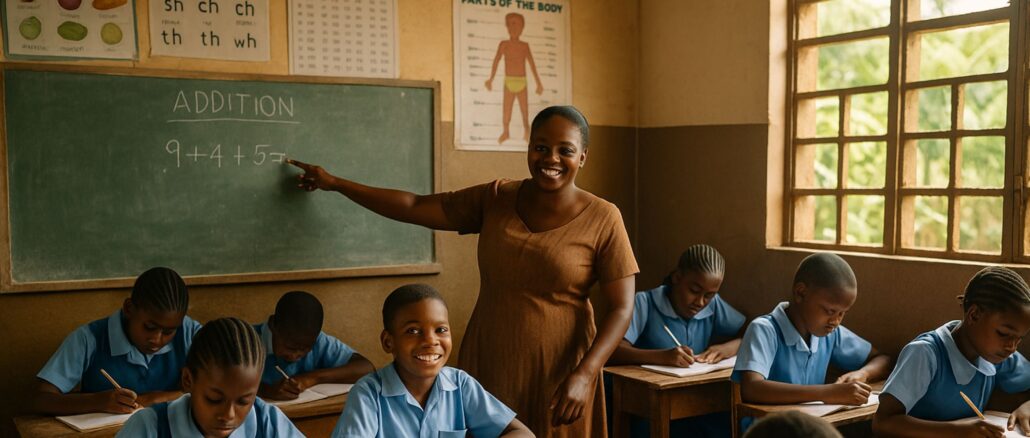
The program has attracted significant international support. The World Bank, a key partner, approved a $50 million grant in 2020 to support the FQSE initiative, with additional financing approved in 2023 to extend the project until 2027. The government is allocating this funding to critical system improvements, including the construction of approximately 510 furnished classrooms to close infrastructure gaps in basic education. UNICEF is another vital partner, providing both technical and financial support to the Ministry of Basic and Senior Secondary Education. UNICEF’s work focuses on expanding access to Early Childhood Development (ECD) centers, training thousands of new preschool teachers, and developing alternative learning pathways for children who have fallen out of the formal system.
Despite these efforts and notable gains in school enrollment, significant challenges persist. Learning outcomes remain a primary concern. According to World Bank data, students in Sierra Leone score an average of 316 on a harmonized test scale, where 300 represents minimum attainment and 625 represents advanced attainment, indicating that simply being in school does not always translate to effective learning. Furthermore, dropout rates are a serious issue, particularly as students advance. While primary school completion is relatively high, out-of-school rates climb to 19% for junior secondary school and a concerning 36% for senior secondary school. These statistics underscore that the FQSE program is a long-term, generational investment whose full impact will take years to materialize.
Pillar 2: Youth Empowerment and Job Creation
While the FQSE program lays the groundwork for the future, the government confronts the immediate and politically sensitive challenge of high youth unemployment, a significant issue for voters in the 2023 election. To address this, the administration has launched a series of targeted, demand-driven initiatives designed to provide young people with marketable skills and a direct path to employment.
A prime example of this pragmatic approach is a partnership launched in July 2025 between the Ministry of Youth Affairs, the United Nations Development Programme (UNDP), and Sierra Tropical Ltd., a major private-sector agricultural company. This program offers hands-on training in high-demand fields, including machine operations, welding, fabrication, and automobile repair, to an initial cohort of 100 young people. Crucially, the initiative comes with a guarantee of employment from Sierra Tropical Ltd for every trainee who completes the program. This model represents a strategic shift away from previous supply-focused training programs that often left graduates without jobs. It directly links skills development to the concrete needs of the private sector, ensuring a tangible outcome for participants.
The Ministry of Youth Affairs is expanding this model through other collaborations. It has signed a Memorandum of Understanding (MOU) with Milton Margai Technical University to unify and scale up skills training programs and another with the International Youth Fellowship (IYF) to empower youth further. These initiatives are concrete expressions of the National Youth Policy, which aims to move beyond rhetoric and unleash the economic potential of the country’s vast youth population. By pursuing this dual-pronged strategy—long-term educational reform through FQSE and immediate job creation through vocational partnerships—the government is attempting to build for the future while delivering visible, confidence-building results in the present.
Feeding the Nation: The FEED SALONE Revolution
Launched in October 2023, the “Feed Salone” initiative is the centerpiece of the SLPP government’s economic agenda. It is far more than a simple agricultural policy; it is a comprehensive, multi-purpose strategic tool designed to tackle some of Sierra Leone’s most pressing challenges simultaneously. The program’s core objectives are to enhance agricultural productivity, significantly reduce the nation’s heavy reliance on food imports, increase export earnings, create sustainable employment opportunities in rural areas, and foster resilience to climate change.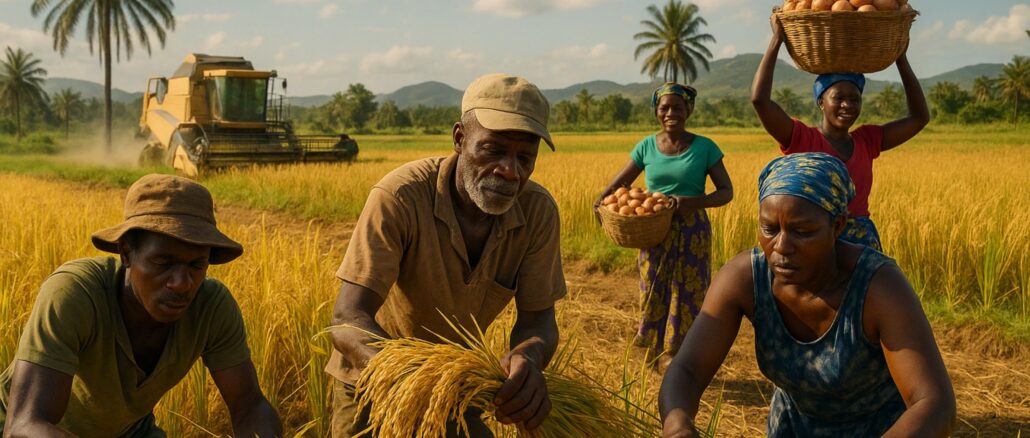
This ambitious agenda directly addresses the primary concerns of the electorate. The high cost of living, driven by rising food prices, was a dominant issue during the 2023 election campaign. By focusing on increasing domestic production of key staples, Feed Salone aims to stabilize food prices and improve food security for millions of households. The government has strategically prioritized investment in value chains for rice, poultry, and onions—three commodities that are highly consumed but largely imported—alongside cassava for domestic food security and cashew and cocoa for their export potential.
The program’s comprehensive structure and alignment with global development goals have made it a magnet for international support. The World Food Programme (WFP) is a key partner, integrating Feed Salone into its Home-Grown School Feeding Program. In 2024, the WFP procured 616 metric tons of locally grown rice and 400 metric tons of pulses, injecting over $840,000 directly into the rural economy and supporting the livelihoods of 12,500 farming households.
The Food and Agriculture Organization (FAO) is providing crucial technical assistance to the Ministry of Agriculture and Food Security, helping to operationalize the program’s pillar on aggregation, processing, and market linkages to ensure that farmers can efficiently reach consumers with their products. In a major boost for the rice sector, the African Development Bank (AfDB) is collaborating with the government to establish the Sierra Leone Rice Special Agro-Processing Zone (SAPZ), an initiative designed to create modern agro-industrial hubs to transform rice production and processing.
The first-year progress report for Feed Salone, covering the period from August 2023 to September 2024, indicates that a solid foundation has been laid for transforming the agricultural sector and repositioning farming as a profitable business.21 This claim is substantiated by independent data. The World Bank has reported notable productivity gains in the program’s first year, with yields for several key crops and sectors exceeding their initial targets.
| Crop/Sector | 2024 Target | 2024 Actual Result | Key Partners | |
| Rice Yield | 2.4 mt/ha | 2.76 mt/ha | AfDB, WFP, FAO | |
| Maize Yield | 2.2 mt/ha | 2.84 mt/ha | WFP, FAO | |
| Onion Yield | 7 mt/ha | 16.3 mt/ha | FAO | |
| Broiler Live Weight | 1.6 kg | 2.6 kg | FAO, IFAD | |
| Hen-Day Egg Production | 75% | 95% | FAO, IFAD | |
| Data Source: World Bank; Partner Information synthesized from |
These early results demonstrate the potential of the Feed Salone strategy. It serves as the linchpin of the government’s entire second-term agenda, connecting its political imperative to address the cost of living with its economic goal of driving growth and creating jobs. The program’s success is central to the country’s monetary projections, which forecast growth accelerating to 4.4% in 2025 and 4.8% in 2026, primarily driven by expected expansions in the agriculture and mining sectors. By functioning as a vehicle for food security, a framework for attracting international finance, and an engine for rural employment, Feed Salone has become the central pillar upon which the administration is building its vision for a more prosperous and self-sufficient Sierra Leone.
A Prescription for Progress: Rebuilding Healthcare
Recognizing that a healthy population is the bedrock of national development, the SLPP government has prioritized significant investments in the healthcare sector. The administration’s strategy has focused on high-visibility, high-impact capital projects that provide tangible, immediate evidence of progress and directly address critical gaps in service delivery. This approach is politically astute, as it creates undeniable symbols of “delivery” that resonate strongly with the public and reinforce the government’s narrative of performance.
The “360-Day Accelerated Delivery Report,” presented in July 2024, detailed a series of concrete achievements in health infrastructure. Key among these were:
- The construction of six new peripheral health units is designed to expand primary care access to underserved and remote communities, decentralizing healthcare away from the main urban centers
- The installation of twelve new oxygen plants in government hospitals nationwide. This addresses a critical lesson from the COVID-19 pandemic and other health emergencies, where a lack of medical oxygen proved to be a fatal bottleneck. A 2022 UNICEF tender for the construction of plants in seven hospitals—including major facilities like Ola During Children’s Hospital, 34 Military Hospital, and district hospitals in Pujehun, Kailahun, and Kabala—illustrates the scale and strategic nature of this nationwide effort.
- The establishment of the National Public Health Agency aims to improve the country’s capacity for disease prevention, surveillance, and response.6
The flagship achievement in the health sector during this period was the commissioning of the Lumley Paediatric Centre of Excellence in Freetown on June 14, 2024. This state-of-the-art facility, officially named the President Dr. Julius Maada Bio Pediatric Center of Excellence, represents a monumental step forward for child health in Sierra Leone.30 Funded by a $25 million grant from the government of Japan, the hospital is an ultra-modern complex featuring 166 beds for children and 46 beds for the mothers of newborns. It is equipped with advanced medical supplies and specialized departments for pediatric surgery, neonatal care, pediatric neurology, and haemato-oncology.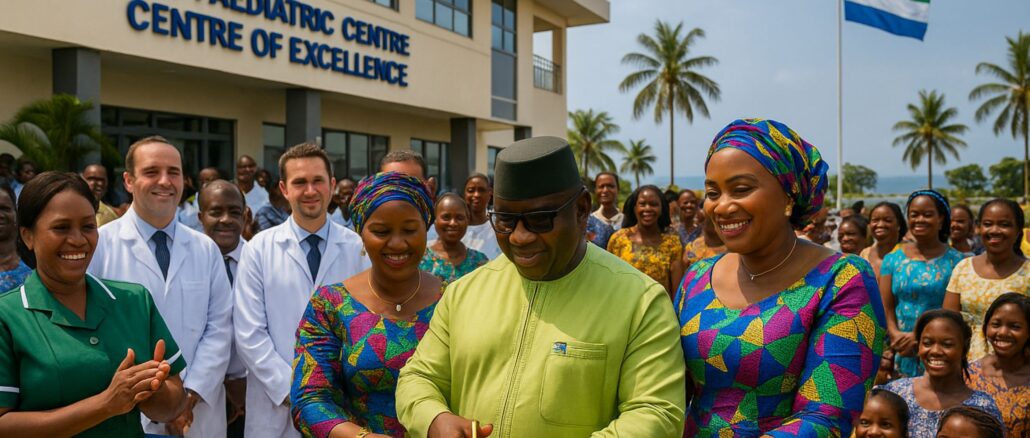
This investment is aimed squarely at tackling Sierra Leone’s historically high rates of maternal and child mortality. At the hospital’s commissioning, officials emphasized that the facility would end the need for families to bear the heavy financial and emotional burden of traveling overseas for specialized pediatric treatment. The government has directly linked these “intentional and purposeful” investments to a reported 61% reduction in maternal mortality in recent years. The Lumley hospital builds on previous efforts, such as the 2019 opening of the King Harman Maternal and Child Hospital, which was supported by the United Kingdom and the United Nations Population Fund (UNFPA).
By focusing on such visible and impactful projects, the government is executing a clear strategy. A new, modern hospital is a powerful physical symbol of progress that can be easily communicated and understood by all citizens. It is not an abstract policy change but a concrete facility that saves the lives of children. The commissioning ceremony, attended by the President and First Lady, was as much a political communication event as a health milestone, designed to showcase achievement and build public confidence. This focus on tangible infrastructure is a deliberate and effective strategy to demonstrate performance, address a core anxiety of the population, and build political capital.
A New Foundation: Landmark Legal and Social Reforms
Alongside its focus on delivering economic and social services, the Bio administration has pursued an ambitious legislative agenda aimed at modernizing Sierra Leone’s legal framework, advancing human rights, and strengthening governance. This reform program appears to be crafted for two distinct but complementary audiences: a global audience of international partners and rights organizations, and a domestic audience concerned with justice, equality, and accountability.
Abolition of the Death Penalty
One of the most significant reforms was the abolition of the death penalty. On July 23, 2021, the Parliament of Sierra Leone voted unanimously to end capital punishment, a move that President Bio formalized by signing The Abolition of the Death Penalty Act into law on October 8, 2021. The law replaced the death penalty for crimes such as murder, treason, and aggravated robbery with a maximum sentence of life imprisonment, with a minimum term of 30 years for murder. This decision fulfilled a long-standing pledge and was widely praised by the United Nations and international human rights groups, positioning Sierra Leone as a progressive leader on the African continent and enhancing its global standing.
Gender Equality and Women’s Empowerment (GEWE) Act
Another landmark achievement was the passage of the Gender Equality and Women’s Empowerment (GEWE) Act in 2022. This transformative legislation is designed to dismantle systemic barriers and increase women’s participation in all spheres of public life. A key provision of the Act requires a minimum of 30% of all public appointments and elective positions to be reserved for women.
The impact of this law was immediately visible in the results of the June 2023 general election. The number of women elected to Parliament more than doubled, increasing from 19 in the previous legislature to 42. Women now constitute 28.2% of the total 149 members of Parliament, a significant leap forward for gender representation in the country. While advocates note that this figure still falls just short of the 30% quota and that challenges in implementation remain, the progress is undeniable. Beyond political representation, the GEWE Act also extends paid maternity leave to a minimum of 14 weeks and establishes a Women’s Empowerment Fund to provide financial support to female entrepreneurs.
Strengthening Governance and Fighting Corruption
In its first year, the sixth Parliament demonstrated a high level of productivity, enacting seven critical bills, passing twelve statutory and constitutional instruments, and ratifying thirteen international agreements. This legislative output signals a commitment to strengthening the country’s governance framework.
A central part of this effort is the focus on transparency and anti-corruption. The Anti-Corruption Commission (ACC) and the Audit Service Sierra Leone (ASSL) are key institutions in the fight against corruption. The 2023 Auditor General’s Report, tabled in Parliament in December 2023, was publicly commended by ACC Commissioner Francis Ben Kaifala and civil society organizations, such as the Budget Advocacy Network, as a vital tool for ensuring public accountability. The ACC has pledged to use the findings of the audit report to launch investigations into areas of concern, particularly regarding revenue loss and payroll management, signaling a proactive stance against graft.
This commitment is further institutionalized through Sierra Leone’s participation in the Open Government Partnership (OGP). The country’s OGP action plan for 2024–2028 includes specific commitments to establish and strengthen Integrity Management Committees in all government ministries, departments, and agencies. It also aims to create a public legislative portal that allows citizens to access and comment on draft laws, thereby increasing transparency in the management of the country’s extractive industries.
These reforms serve a dual purpose. Progressive social laws, such as the abolition of the death penalty and the GEWE Act, align with the values of international partners, strengthening diplomatic ties and potentially unlocking further development aid. At the same time, the domestic focus on anti-corruption and accountable governance directly addresses long-standing citizen grievances, working to build trust in public institutions from the ground up.
From Margai to Bio: Charting the Course for 2028
The current administration’s policies are not being framed in a vacuum. The Sierra Leone People’s Party (SLPP) is strategically positioning its “Big Five” agenda as the modern fulfillment of the party’s core historical missions, drawing a direct line from its founding fathers to its present leadership. This narrative of historical continuity aims to foster party cohesion and legitimize its current direction by grounding it in a revered past.
Honoring a Legacy: The SLPP’s Historical Leaders
The SLPP’s identity is deeply connected to two iconic leaders whose legacies continue to shape the nation’s political consciousness.
Sir Milton Margai (1895-1964), the party’s founder and Sierra Leone’s first Prime Minister, is remembered as the father of the nation. He led the country to independence from Britain in 1961 and dedicated his career to the foundational tasks of nation-building. A medical doctor by training, he pioneered community-based public health initiatives, establishing clinics, training midwives, and promoting hygiene education in rural areas.42 His focus on education, health, and unifying the country’s diverse ethnic groups laid the groundwork for the modern state. The current administration’s emphasis on “Human Capital Development” through the FQSE and healthcare investments is a direct thematic descendant of Sir Milton’s foundational work.
Ahmad Tejan Kabbah (1932-2014) presided over Sierra Leone during one of its darkest and most triumphant periods. His successful effort to end the brutal 11-year civil war defines his presidency. President Kabbah demonstrated exceptional diplomatic skill by negotiating peace accords, most notably the 1999 Lomé Peace Agreement with rebel leader Foday Sankoh. When peace efforts faltered, he successfully campaigned for decisive international intervention from the Economic Community of West African States (ECOWAS), the United Nations, and the United Kingdom, which ultimately brought the conflict to an end in 2002.
Beyond peace, his legacy includes the establishment of crucial democratic and accountability institutions, including the Anti-Corruption Commission (ACC) and the National Social Security and Insurance Trust (NASSIT). Perhaps his most enduring contribution was overseeing a peaceful and democratic transfer of power to the opposition in 2007, a critical precedent that solidified the country’s return to stability. The current government’s work to strengthen these same institutions and maintain peace after a tense election builds directly on the foundation Kabbah secured.
Looking Ahead: The 2025 National Delegates Conference and the 2028 Vision
With this historical context in mind, the SLPP is now looking toward the future. A critical event on the horizon is the 14th National Delegates Conference, scheduled for July 30, 2025. This conference will be a pivotal moment for the party to debate its policy direction, reinforce its commitment to internal democracy, and elect a new national executive to guide it toward the 2028 general elections. The current executive, led by Dr. Prince Alex Harding, is credited with steering the party to victory in both the 2018 and 2023 elections.
President Bio is expected to use the occasion to deliver a keynote address, calling for unity and visionary leadership, and framing the internal elections as a “contest of character, not chaos; of vision, not vitriol.” The conference will set the political strategy for the remainder of the presidential term, focusing on consolidating the gains from the “Big Five” agenda. The economic outlook provides a basis for this forward-looking strategy, with growth projected to reach 4.8% by 2026, driven by the anticipated success of the Feed Salone program and continued expansion in the mining sector.
By invoking the legacies of Margai and Kabbah, the Bio administration is crafting a powerful narrative arc: Sir Milton built the nation, President Kabbah secured the peace, and the current government is now tasked with creating the country’s future prosperity on that solid foundation. The 2025 conference will serve as a platform to formalize this vision, uniting the party around a shared sense of historical purpose as it prepares for the challenges and opportunities ahead of 2028.
By invoking the legacies of Margai and Kabbah, the Bio administration is crafting a powerful narrative arc: Sir Milton built the nation, President Kabbah secured the peace, and the current government is now tasked with creating the country’s future prosperity on that solid foundation.
A Foundation Built, A Future to Secure
The first year of the SLPP government’s second term was marked by intense and calculated action. Emerging from a contentious election that created a challenging political climate, the administration embarked on an agenda of “accelerated delivery” aimed at producing tangible results and solidifying its mandate. The evidence from this first year, documented in the government’s own “360-Day Report” and largely corroborated by independent sources, points to the laying of a strong foundation for future progress.
In agriculture, the flagship FEED SALONE program has transitioned from concept to implementation, attracting significant international partnerships and yielding impressive early results in crop productivity that surpass initial targets. In education, the long-term investment in the Free Quality School Education program continues, complemented by pragmatic, short-term vocational training initiatives that provide direct pathways to employment for youth. The healthcare sector has seen the most visible signs of progress, with the construction of new health units, the installation of critical oxygen plants, and the commissioning of a state-of-the-art national children’s hospital—all concrete symbols of a commitment to improving the well-being of citizens.
On the legislative front, landmark reforms abolishing the death penalty and promoting gender equality have enhanced Sierra Leone’s international standing; meanwhile, a domestic focus on anti-corruption aims to build public trust.
This strategy was a multi-faceted response to a complex environment. It blended long-term foundational programs with short-term, high-visibility projects to demonstrate both vision and immediate impact. It pursued a dual-track reform agenda aimed at satisfying the expectations of both the international community and the domestic population.
However, the challenges ahead remain significant. The economic headwinds that defined the 2023 election, including high inflation and the cost of living, persist. The political divisions exposed during the election require ongoing efforts to maintain national unity and cohesion. The ultimate success of President Bio’s “New Direction” will depend on the government’s ability to sustain the momentum of this first year. The foundation has been built, but the next challenge is to ensure that the benefits of these ambitious programs—from the farms of the Feed Salone initiative to the classrooms of the FQSE program—are felt by every Sierra Leonean. The task now is to build upon these gains and secure a more stable, prosperous, and equitable future for all.
Call to Action:
SLPP Today welcomes comments from readers. Stay informed and engaged. Share this story and join the conversation on Sierra Leone’s path forward. Together, citizens can hold leaders accountable and help keep the nation moving in the right direction.